
What Is a Partial Hospitalization Program – and Who Is It Designed For?
Partial Hospitalization programs involve staying at a rehab facility for 5 – 6 hours a day, 5 days a week, while engaging in group and individual therapy. It is designed for people who need more structure than traditional outpatient care but don’t require 24/7 supervision. This article will go into depth about what it entails.
Key Takeaways
- Partial hospitalization programs involve clients attending group and individual therapy 5-6 hours a day, 5 days a week, to treat substance abuse and mental health issues.
- PHP is typically followed by intensive outpatient programs and traditional outpatient treatment as part of the continuum of care.
- This therapy structure is best for individuals who need structured support but don’t require 24/7 supervision.
Table of Contents
- How Do Partial Hospitalization Programs (PHPs) Fit Into the Continuum of Care
- What Does an Average Day in PHP Look Like?
- Who is PHP Designed For?
- What Should I Expect When Starting a PHP?
- BlueCrest is a Go-To for PHP Care in New Jersey
- FAQs
Introduction
Partial care or partial hospitalization programs are designed to address substance abuse and mental health issues. Clients typically stay in the facility 5 – 6 hours a day, 5 days a week, and engage in individual and group therapy, and other healthy activities to promote healing. Care is typically provided in standalone facility, but can also be offered in a hospital setting.
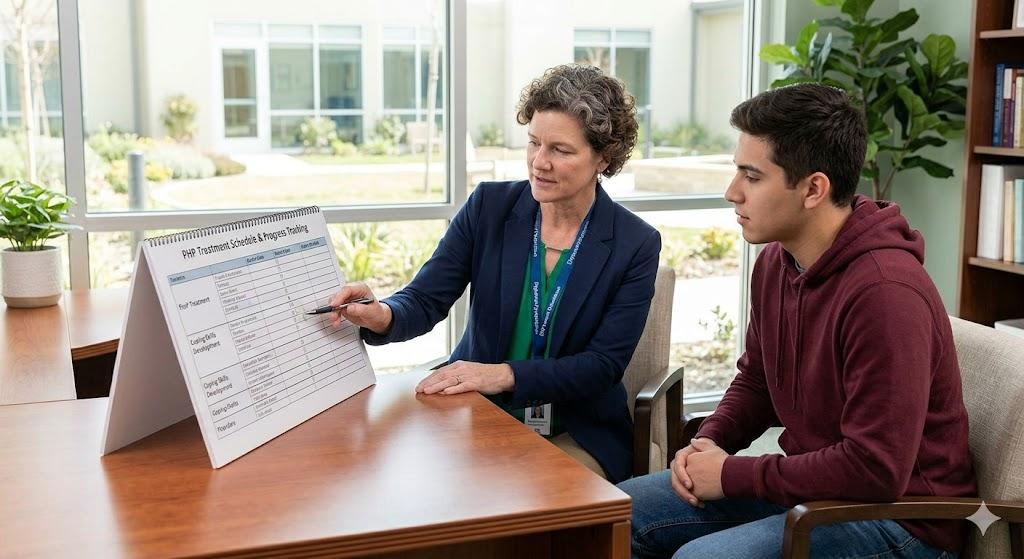
This article will tell you what’s involved in partial hospitalization, so you can determine if it’s the right move for yourself or a loved one. BlueCrest Recovery offers effective outpatient services in New Jersey and can guide you through the process to help you find the best solution.
How Do Partial Hospitalization Programs (PHPs) Fit Into the Continuum of Care
Partial Hospitalization Programs (PHP) provide more intensive treatment than outpatient services but do not require the overnight stays associated with inpatient care, making them a middle ground in mental health treatment options. PHP can be a step down from inpatient care or a primary form of care for individuals who don’t require as intense treatment. After completing partial care, clients may move on to other outpatient services, such as:
- Intensive Outpatient Programs: Clients attend shorter sessions, 3-5 days a week.
- Traditional Outpatient: Consists of regular sessions, 1-2 times a week.
What Does an Average Day in PHP Look Like?
On an average day in PHP, a client may engage in various therapies, receive medical management oversight, attend workshops, and participate in healthy activities with other group members. Here’s what that might look like.
Morning Check In
Clients check in to discuss how they are feeling that day and review any relevant events that have come up since the last session. If the person is taking medication, an on-site professional may review the side effects and adjust prescriptions accordingly.
Therapy Meetings
Meetings are held throughout the day, and may include:
- Group Therapy: Clients may attend two to four group therapy sessions per day, integrating evidence-based modalities such as cognitive behavioral therapy (CBT), dialectical behavioral therapy (DBT), and motivational interviewing. These approaches are designed to address mental health concerns and teach clients healthy coping strategies.
- Individual Therapy: Just as effective as group therapy, according to a 2004 NIH study, individual therapy consists of one-on-one counseling sessions to address personalized treatment goals and track recovery milestones. During these sessions, clients meet with their primary mental health professional, digging deeper into personal issues that may cause emotional distress.
- Psychoeducation & Skill-Building workshops help patients understand their diagnoses and learn coping skills for stress management, emotional regulation, and relapse prevention. Many programs include structured educational topics, covering the neuroscience of addiction, such as how substances affect the brain and body, providing clients with a deeper understanding of how drugs affect their systems.
Activities
Individuals in PHP may also engage in the following activities.
- Specialty Groups: These may include family therapy sessions, trauma-informed care, life skills workshops, and 12-step meetings.
- Experiential & Holistic Therapies, such as art therapy and mindfulness, can be incorporated into PHPs.
- Family Therapy sessions involve family members to improve communication and establish a healthy home environment.
- Medication Management involves regular evaluations with a staff psychiatrist to safely prescribe, monitor, and adjust psychiatric medications.
Lunch and Peer Support
Lunchtime occurs mid-afternoon. It’s an opportunity for clients to bond. They often participate in preparation and clean-up, learning responsibility and accountability.
End of Day Wrap Up
Before clients leave, they reflect on the day, mention key takeaways, and prepare to transition back to their home environment.
Who is PHP Designed For?

PHP is not for everyone. It is best for individuals who require structured care but don’t necessarily need 24/7 supervision. Here are some qualifying characteristics:
- People Stepping Down From Residential Care: PHP is often a follow-up for individuals who have completed inpatient care and are transitioning to daily life.
- Those Who Need a Supportive Environment: This type of addiction and mental health treatment is suited for those who need the structure of a regular routine but are stable enough to forgo 24/7 care.
- Individuals with Co-occurring Mental Health Disorders: Partial Hospitalization Programs (PHP) are beneficial for adults experiencing significant mental health challenges, such as depression, anxiety disorders, bipolar disorder, and trauma-related conditions. These often co-occur alongside dependency issues impacting about 31.5% of people with SUDs, according to a SAMHSA study.
- People with a Stable Home Environment: Outpatient treatment is typically more effective if your family supports your recovery and can help you with transportation and scheduling.
- Those Who Can’t Step Away from Family Responsibilities: The outpatient approach is suitable for people who can’t take time away from their families for treatment.
- Individuals with a Low Relapse Risk: While relapse is an issue for many individuals in recovery, those in PHP should not be facing an acute crisis.
What Should I Expect When Starting a PHP?
Starting a PHP requires an intake and assessment process, an orientation, and then moves on to therapy and aftercare planning. Here’s what you can expect:
- Intake: The admissions team will review your insurance company plan to determine what coverage is available and let you know how much you will pay. Most insurance plans cover Partial Hospitalization Programs (PHP) as a medically necessary form of mental health treatment, but coverage can vary by provider and policy. The clinical staff will also ask you basic questions about your medical and mental health needs, and personal information.
- Assessment: Next comes a careful assessment process. A therapist and other professionals will evaluate your mental and physical health and symptoms, diagnose your condition, and ensure they offer safe and effective treatment.
- Orientation: During the first few days, you will get to know the other patients and your therapist, and learn about your treatment plan.
- Aftercare and Planning: After PHP is complete, the team will guide you through the aftercare planning process. They may recommend an IOP program and healthy habits to ensure safety and prevent relapse.
BlueCrest is a Go-To for PHP Care in New Jersey
BlueCrest offers comprehensive care to individuals struggling with addiction and mental health conditions. We provide PHP, IOP, outpatient services, and after with an evidence-based approach customized to clients’ needs. Our team has lived addiction firsthand, ensuring a compassionate approach that considers the physical, mental, and spiritual aspects of dependency issues.
Contact us to learn more about our specialized approach.
FAQs
How long does PHP last?
Programs are short-term and outcome-focused, generally lasting between 2 and 4 weeks before a patient steps down to less intensive care. However, the duration can vary depending on individual needs.
Can I work or go to school while in PHP?
It can be difficult to maintain a work or school schedule while in PHP, as it will take up a good chunk of your day, and it is best to focus on healing. However, BlueCrest offers an evening program for those who can’t step away from daily responsibilities. It may allow for remote and part-time work.
Do I Need to Have Completed Detox or Inpatient Treatment First?
Not necessarily. While many patients enter PHP as a step-down from inpatient or residential treatment, others enter directly from the community if they don’t require a higher level of medical supervision. The intake assessment will determine the most appropriate level of care.
Sources
- SAMHSA. “Results of the 2024 National Survey on Drug Use and Health.” https://www.samhsa.gov/newsroom/press-announcements/20250728/samhsa-releases-annual-national-survey-on-drug-use-and-health
- SAMHSA. “Release of the 2024 National Survey on Drug Use and Health: Leveraging the Latest Substance Use and Mental Health Data.” https://www.samhsa.gov/blog/release-2024-nsduh-leveraging-latest-substance-use-mental-health-data-make-america-healthy-again
- National Association of Counties. “SAMHSA Releases New 2024 Data on Rates of Mental Illness and Substance Use Disorder in the U.S.” https://www.naco.org/news/samhsa-releases-new-2024-data-rates-mental-illness-and-substance-use-disorder-us
- NIDA. “Principles of Drug Addiction Treatment: A Research-Based Guide (Third Edition).” https://nida.nih.gov/sites/default/files/podat-3rdEd-508.pdf
- Han B, Compton WM, Blanco C, Colpe LJ. “Prevalence, Treatment, And Unmet Treatment Needs Of US Adults With Mental Health And Substance Use Disorders.” Health Affairs. https://pubmed.ncbi.nlm.nih.gov/28971928/
- Magill M, Ray LA. “Cognitive-Behavioral Treatment With Adult Alcohol and Illicit Drug Users: A Meta-Analysis of Randomized Controlled Trials.” Journal of Studies on Alcohol and Drugs. https://pmc.ncbi.nlm.nih.gov/articles/PMC2696292/
- Magill M, et al. “A Meta-Analysis of Cognitive-Behavioral Therapy for Alcohol or Other Drug Use Disorders.” Journal of Substance Abuse Treatment. https://pmc.ncbi.nlm.nih.gov/articles/PMC6856400/
- Kiluk BD, et al. “An Evaluation of Cognitive Behavioral Therapy for Substance Use Disorder: A Systematic Review and Application of the Society of Clinical Psychology Criteria for Empirically Supported Treatments.” PubMed/PMC. https://pmc.ncbi.nlm.nih.gov/articles/PMC10572095/
- López G, Orchowski LM, Reddy MK, Nargiso J, Johnson JE. “A Review of Research-Supported Group Treatments for Drug Use Disorders.” Substance Abuse Treatment, Prevention, and Policy. https://pmc.ncbi.nlm.nih.gov/articles/PMC8215831/
- Weiss RD, et al. “Group Therapy for Substance Use Disorders: What Do We Know?” PubMed. https://pubmed.ncbi.nlm.nih.gov/15764469/
- Linehan MM, et al. “Dialectical Behavior Therapy for Patients With Borderline Personality Disorder and Drug-Dependence.” PubMed. https://pubmed.ncbi.nlm.nih.gov/10598211/
- Opperman K, et al. “Effectiveness of Dialectical Behavior Therapy (DBT) in a Forensic Psychiatric Hospital.” Journal of the American Academy of Psychiatry and the Law. https://pubmed.ncbi.nlm.nih.gov/38834364/
- Schwenker R, et al. “Motivational Interviewing for Substance Use Reduction.” Cochrane Library. https://www.cochranelibrary.com/cdsr/doi/10.1002/14651858.CD008063.pub3/full
- Barnett E, et al. “Motivational Interviewing for Adolescent Substance Use: A Review of the Literature.” PubMed. https://pubmed.ncbi.nlm.nih.gov/22958865/